
Dino Wars - Kyouryuu Oukoku e no Daibouken Gameplay
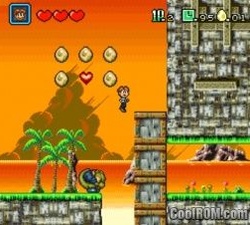
“Dino Wars” — the very same Dino Wars that listings often filed under the Japanese Kyouryuu Oukoku e no Daibouken. The title promises a grand trek to the dinosaur kingdom — and in practice you’re getting a straight-up classic SNES platformer about dinos, the kind where you catch the beat in seconds and start living by the tempo of hops, short bursts, and tidy strikes. It’s less about knowing the route and more about feeling when to press, when to ease off, and when to risk it for a bonus life.
Run, jump, hit
Playing Dino Wars is all about the feel in your hands: running is smooth, acceleration has weight, and jump timing clicks after two or three tries, like you’re locking onto the level’s internal metronome. Your attack is close-range with a small arc, so straight-up trading is dangerous; it’s better to clip an enemy on approach, hop back, and finish from a safer spot. When two or three foes share the screen, that old-school difficulty shows up — not cheap shots, but an honest check of your reactions.
Every location is a chain of short challenges. Low ledge, high lip, narrow bridge, rolling boulder — combined in ways that keep your momentum up. Vines swing just long enough to read the arc; moving platforms won’t betray you, but they won’t forgive an extra heartbeat either. Find the groove and you almost “flow” through a stage, losing track of time while your senses do careful, tactile work.
Secrets and small wins
Secrets here reward curiosity: glance off the main path, cut a corner — and you’ll find a hidden bonus, an extra life, or a continue. Sometimes it’s a stone that looks out of place, sometimes a dark ledge in a cave you can reach with a jump. These tiny victories build confidence before the next block of trials that lean on coordination and jump timing. That’s how the game teaches: not with pop-ups, but by reinforcing good habits — look around, take a chance, discover, then slide back onto the main line.
Scoring actually feels good — not for a leaderboard, but because points feed useful loot: health, brief invulnerability, and throwables that save the day when an enemy parks in an awkward spot. It’s the kind of “collecting” that’s baked into the level’s breathing: grab something and you immediately feel the next string of obstacles go down smoother.
Level rhythm
Progress rolls out world by world, and each new set nudges your muscle memory into a slightly different groove. The jungle favors speed jumps and slippery landings. Caves add vertical play: climbs, ledges, careful drops past spikes. Ancient ruins bring bone tiles that crumble underfoot and long gaps that make you trust your run-up. That shift of emphasis makes the game feel like a series of short lessons: you’re not memorizing as much as you’re adapting to its logic.
Checkpoints are placed smartly. You reach them with effort: a couple of clean stretches, a couple of grit-your-teeth sections — and then it’s calm enough to risk a detour for a secret. If you fail, you don’t respawn in purgatory; you’re back in a slice where the memory of success is still fresh. So even as lives melt away, your thumb goes for Continue — not out of stubbornness, but because you can feel the progress.
Boss duels
The end-of-stage boss is its own little play. Patterns don’t read instantly, but they’re fair: strike, pause, dash, weak spot. First attempt, you’ll eat a hit; second, you’re studying; by the third, you slip into the cadence and hit that small catharsis — a tidy dodge string, two clean strikes, victory chime. No “super moves” required: the magic is in not rushing and syncing to the duel’s tempo. It’s the kind of old-school design where clear rules and sharp feedback beat any on-screen tip.
How it feels
The best part is how “Dino Wars: A Big Adventure to the Dinosaur Kingdom” wires into your hands. You start measuring distance in little eye-grid squares, like your favorite Super Famicom platformers: two steps to here, a jump from the edge there, a short pop-hit on the rebound. The music keeps the pulse — chiptune drums lay down the perfect meter to march to and layer your own tempo on top. Hit confirms go click, pickups give a satisfying tink, and that’s enough to drip-feed dopamine for every neat micro-win.
Stages never overstay their welcome: dash through, figure it out, pass the boss exam — and here’s your password to continue from the next world. It’s a friendly, proudly retro setup where the password system spares you marathon runs and lets you pick up in the evening right where you left off. In the end the playthrough becomes a steady trek: no tempo crashes, clear feedback, and that exact sensation that makes us love adventure platformers on the SNES.
One more thing that sticks: the game doesn’t break you with RNG. Even when traps feel mean, they’re honest. Every “whoops” is a lesson. One world teaches you to thread a tiny window between spikes, another to trust a long runway, a third to use throwables not in panic but on the beat. When it all clicks, Dino Wars opens up fully — not “just another dinosaur platformer,” but a rhythmic adventure where you become the conductor of your own run.
That’s Kyouryuu Oukoku e no Daibouken in action: hands-on feel, a sense of tempo, and a love of small victories. No over-explaining, no droning — just clean flow that leaves you with a calm smile and the thought: one more world, then bed.